Wednesday, 26 February 2020

5.6.- Writing: Purpose links and how to write a proposal


Listening Exercise of Sentence Completion about the video: How Ski Dubai stays frozen at 40oC on Topworksheets:

https://www.topworksheets.com/t/DS5z2OqHUK9

Video link on Youtube of the video How Ski Dubai stays frozen at 40oC:

Purpose Linkers from the Ski Dubai Video script

Purpose LinkStructureExample from the textUse / Meaning
In order toin order to + base verbEngineers work continuously in order to keep the snow in perfect condition.Used to express purpose in a formal way. Shows why someone does something.
In order thatin order that + subject + verbCooling systems operate day and night in order that the snow does not melt.Used to explain the purpose of an action when the sentence has a different subject.
Soverb + so + result / purpose clauseFresh snow is added every day so visitors can enjoy a safe skiing experience.A more informal way to express purpose or result.
So as toso as to + base verbMachines create artificial snow so as to maintain the correct texture.Formal structure used to explain purpose. Similar to in order to.
So as not toso as not to + base verbMachines smooth the snow so as not to leave uneven areas.Used to express negative purpose (to avoid something).
So thatso that + subject + verbThe temperature is controlled so that the snow remains firm.Used when the purpose clause includes a subject and verb.
In order not toin order not to + base verbTechnicians check equipment in order not to risk mechanical failures.Used to express negative purpose in a formal way.

Quick tip:

  • When the subject is the same, we usually use to / in order to / so as to.

  • When the subject changes, we use so that / in order that.


What is your life purpose?

For example, 'My life purpose is to visit as many countries as possible.'


My life purpose is to...


Collaborative Online Exercise on Wordwall:

https://wordwall.net/es/resource/96123621

Individual Exercise 1 on page 46


Collaborative Reading of the Proposal on page 47


Collaborative Exercise 4 on pages 46 and 47


How to write a proposal


What a proposal really is


A proposal is a document that outlines a plan of action, request for funding, or proposal of an idea. Proposal writing is a process organizations follow for proposal creation. Proposal writing can be used in various settings, including business, academia, and government. In each case, the goal is to present a clear and concise plan to convince the reader to approve the proposal.


It offers comprehensive information about the project an organization wants to implement. It outlines the process and resources required to complete the project successfully. It also includes the objectives and goals of the project.


What a typical proposal task looks like

I typical proposal looks like a report. 


When writing a proposal, there are two things you need to ask yourself before you even start to make a plan:

  1. What do I have to include in my proposal?
  2. Who is going to read it?


As proposals are written to local or school authorities, tutors or teachers, formal  English is required so contractionscolloquial expressionsslang or phrasal verbs that convey informality are not allowed.


How to organise your proposal


1.- Title

2.- introduction

3.- Topic Paragraphs (between 2 and 3)

4.- Conclusion


The different parts of a proposal

In this part we are going to look at the example from the beginning of this post again and I’m going to walk you through writing a proposal step by step so you know exactly how this whole thing works. Of course, the topic changes from task to task, but if you understand the essence, you will be able to apply this knowledge to every future task.

1.- Introduction

A proposal is a rather factual and informative piece of writing so it is not your job to make it sound happy or sensational (as you would in a review or possibly an informal email). Therefore, your introduction should get straight to the point. Say what the proposal’s purpose is and what you are going to include. It is also important to note that you should never just copy the words from the task, but paraphrase them and use your own words instead.

Some useful language for an introduction includes (but is not limited to) the following phrases:

  1. The purpose/aim of this proposal is to…
  2. This proposal is intended to show/discuss/suggest/outline...


2.- Topic paragraphs

In your topic paragraphs you deal with the three different main points from the task. As mentioned above, you are not required to make this sound sensational, but rather informational and factual.

At the same time, however, you’re trying to convince the local council to consider your proposal so you need to use language to make suggestions and to be persuasive.

The paragraphs should get headings so it becomes evident very easily what you are talking about in each section.


Conclusion

Last but not least, we need a nice and short conclusion to give a last recommendation. Make sure that you try to convince the reader of your idea one more time.

Recommendations in the conclusion:

I would strongly recommend (+verb in -ing)...

It would be advantageous to...

It is recommended that...

In conclusion, I strongly feel that... is/would be the best to...

It would be a good idea to...


Source: https://technicalwriterhq.com/writing/proposal-writing/


https://www.rubenvalero.com/learningenglish/c1-advanced-cae/writing-cae-c1/cae-proposal/


http://cailearning.com/wp-content/uploads/2017/02/Unit-5-Writing-A-Proposal.pdf

5.5.- Speaking: Compound adjectives and Speaking test part 2.

What is he wearing?
What do you think are the functions of the item he's wearing?

📖 C1 Reading Text: A Technological Device in Sports


In recent years, wearable motion-tracking devices have revolutionized the way professional athletes train and recover. Among them, the GPS-enabled smart vest has become increasingly popular across high-performance sports such as football, rugby, and athletics. This lightweight, body-hugging garment contains a small sensor that collects real-time data on speed, distance, acceleration, and heart rate.

For coaches, this device is more than just a fashionable gadget; it provides data-driven, performance-focused insights that were unimaginable two decades ago. By analyzing the numbers, staff can determine whether a player is overtraining, underperforming, or at risk of injury. The highly sophisticated, user-friendly system also allows players themselves to understand their physical limits and optimize their workouts accordingly.

Critics, however, argue that such devices contribute to an overly analytical approach, replacing instinct and creativity with statistics. Some fear that athletes will become excessively dependent on number-based, algorithm-driven strategies, losing the spontaneity that makes sport so engaging. Still, most experts agree that this technology is here to stay, as clubs continue to invest in state-of-the-art, scientifically-backed innovations to maximize performance and protect their players.

In the end, the ever-evolving, competition-oriented world of professional sports seems perfectly suited for these tools. As technology advances, wearable devices will likely become even more precise, adaptable, and indispensable.


📚 References

  • Dyer, B., & Goosey-Tolfrey, V. (2018). The use of technology in sport—Performance analysis and wearable devices. Sports Technology, 11(1), 1–5. https://doi.org/10.1080/19346182.2018.1428732
  • Malone, J., Lovell, R., Varley, M. C., & Coutts, A. J. (2017). Unpacking the black box: Applications and considerations for using GPS devices in sport. International Journal of Sports Physiology and Performance, 12(s2), S218–S226.
  • McCullagh, K. (2019). Technology and innovation in sport: Smart devices for monitoring performance. Journal of Sports Sciences, 37(14), 1612–1619.
  • FIFA. (2020). Evolving technology in football: Wearables and performance data. Retrieved from https://www.fifa.com

Individual Reading Comprehension Exercise:


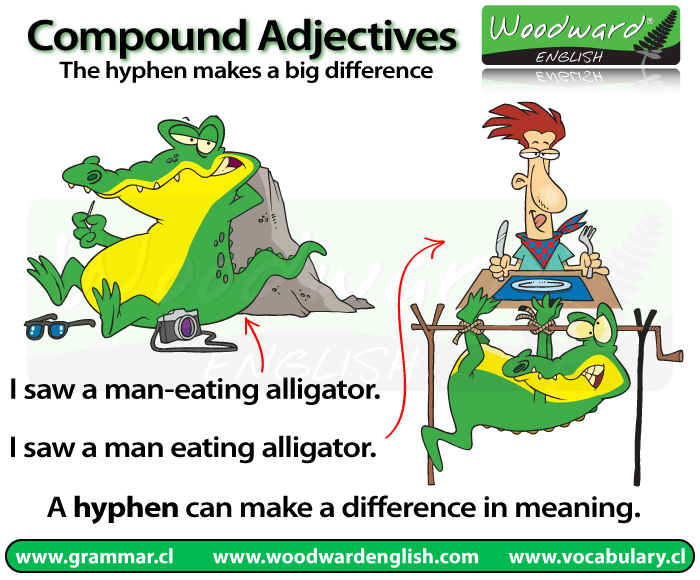
What do you think about people who go hunting?

What animals do you think are hunted?


Collaborative exercise 1 on page 45 on wordwall on 

Online exercise about compound adjectives


Ladies and gentlemen, let me introduce a refined twist on a timeless favorite — the dark-chocolate Snickers bar.

This is not merely a confectionery treat; it is a carefully crafted, flavor-rich experience designed for discerning chocolate lovers. Enrobed in smooth, slow-melting dark chocolate, each bite delivers a bold, cocoa-forward intensity that feels both indulgent and well-balanced.

Beneath its glossy exterior lies a perfectly layered combination of roasted-to-perfection peanuts, a thick-and-silky caramel ribbon, and a soft-and-chewy nougat center. The result is a multi-layered texture that is both satisfyingly crunchy and irresistibly smooth. Every component works in harmony to create a full-bodied, palate-pleasing sensation.

What truly sets this bar apart is its bittersweet sophistication. The rich-and-velvety dark chocolate tempers the sweetness, offering a more mature, flavor-forward profile that appeals to those who appreciate depth and complexity.

Whether you need an energy-boosting snack during a demanding day or a well-deserved, after-dinner indulgence, this premium-quality creation delivers a balanced-yet-bold experience in every bite.

Choose the dark-chocolate Snickers bar — a thoughtfully crafted, taste-enhancing upgrade to an already iconic favorite.

Because excellence, after all, should be both sweet and sophisticated.


Parts of the dark-chocolate Snickers sales speech:


1. Attention-Grabbing Opening (Hook)

“Ladies and gentlemen, let me introduce a refined twist on a timeless favorite — the dark-chocolate Snickers bar.”

This opening creates curiosity by presenting the product as both familiar and upgraded (“refined twist”).

2. Introduction of the Product

“This is not merely a confectionery treat; it is a carefully crafted, flavor-rich experience designed for discerning chocolate lovers.”

Here, the product is clearly introduced and positioned as premium and sophisticated.

3. Problem or Need

Implied need:

People want something more mature, less overly sweet, and more satisfying than ordinary candy bars.

This is reflected in:

“a more mature, flavor-forward profile that appeals to those who appreciate depth and complexity.”

The speech suggests that regular chocolate bars may lack sophistication.

4. Solution (Benefits of the Product)

“Enrobed in smooth, slow-melting dark chocolate… roasted-to-perfection peanuts… thick-and-silky caramel ribbon… soft-and-chewy nougat center.”

Here, the speech explains how the product delivers:

  • Balanced sweetness
  • Rich flavor
  • Multi-layered texture
  • Premium quality

These are strong customer-focused benefits.

5. Evidence or Justification

Instead of statistics, the speech uses descriptive credibility:

“carefully crafted,” “perfectly layered combination,” “full-bodied, palate-pleasing sensation.”

This builds trust through detailed, confident description.

6. Call to Action (Closing)

“Choose the dark-chocolate Snickers bar — a thoughtfully crafted, taste-enhancing upgrade to an already iconic favorite.”

And finally:

“Because excellence, after all, should be both sweet and sophisticated.”

This closing encourages the audience to make a decision and leaves a memorable impression.


Summary Structure Used:

Hook → Product Introduction → Implied Need → Benefits → Descriptive Proof → Persuasive Closing


📝 Assessment Rubric

Poster & Sales Speech Presentation

Total Marks: 10

Criteria

Excellent (2 marks)

Good (1.5 marks)

Satisfactory (1 mark)

Needs Improvement (0.5–0 marks)

Product Content

Product clearly explained; strong, persuasive benefits.

Product mostly clear; some persuasive detail.

Basic explanation; limited benefits.

Product unclear or poorly explained.

Sales Speech Structure

Clear structure (Hook–Problem–Solution–CTA); smooth flow.

Mostly clear structure; minor weaknesses.

Some structure but not well organized.

Disorganized; no clear sales format.

Language & Persuasion

Strong persuasive language; varied vocabulary; few/no errors.

Good vocabulary; minor errors.

Simple language; noticeable errors.

Very basic language; frequent errors.

Poster Design & Visual Impact

Creative, eye-catching, well-organized; visuals support message.

Attractive design; minor layout issues.

Basic design; limited creativity.

Messy, unclear, or incomplete.

Oral Presentation Skills

Confident, fluent, clear voice, strong eye contact; engaging.

Mostly confident; minor hesitation.

Some reading; limited engagement.

Very hesitant; unclear or unprepared.


🔢 Scoring Guide:

Each criterion = 2 marks
Total = 10 marks


Exercise 4 and Speaking Exam Task Practice on page 45

5.2.- Grammar: conditional forms


What characteristics do you think are required for becoming a doctor?


Listening exercise on page 40


When you tell people you’re studying to be a doctor, they sometimes ask whether your family first suggested it to you.


Conversation about considering a doctor's appointment


A: Morning!

B: Hi!

A: How have you been?

B: Good is good, and you?

A: I'm feeling a little under the weather.

B: Why?

A: Because I have had diarrhea for two weeks.

B: Golly gosh! If I feel sick, I go to the doctor.

A: But if I go to the doctor, I will spend a fortune.

B: It doesn't have to cost you an arm and leg if you go to Dr. Simi. If I were you, I would go there.

A: So, you think that if I had gone there, I wouldn't be ill.

B: Of course milord, I'm sure that if you had gone there, you would have got recovered. 

A: Thanks for the advice.

B: Unfortunately as you know I didn't study medicine. However, if I were a doctor, I would have assisted you.


Zero Conditional: If I feel sick, I go to the doctor. 

If + Present Simple, Present Simple -> Facts


First Conditional

If I go to the doctor, I will spend a fortune. 

If + Present Simple, Future -> Possible Present or Future Situations


Second Conditional

If I were you, I would go there. 

If + Past Simple, Past Simple Modal (would, could, should or might) + Verb in Bare Infinitive -> Imaginary Present or Future Situations


Third Conditional

If you had gone there, you would have got recovered. 

If + Past Perfect, Perfect Modal (would/could/should/might + have + Verb in Past Participle) -> Past imaginary situations impossible to change


First Mixed Conditional

If I had gone there, I wouldn't be ill.

If + Past Perfect + Past Simple Modal (would, could, should or might) + Verb in Bare Infinitive ->

Present result from a past condition


Second Mixed Conditional

If I were a doctor, I would have assisted you.

If + Past Simple, Perfect Modal (would/could/should/might + have + Verb in Past Participle) -> Past result from a present condition


I would have assisted you if I were a doctor.

* The clauses in the conditional sentences are interchangeable.


Collaborative Online Exercise:

https://www.englishexercises.org/makeagame/viewgame.asp?id=15222


Individual Online Exercise:

https://quizlet.com/es/840065187/english-conditionals-exercises-0-1-2-3-mixed-flash-cards/


Team Practice: Write in teams two sentences applying each one of the conditional structures in your field of study, so twelve sentences in total will be required to be written.


Conversation about considering a doctor's appointment with alternative words to 'if'

A: Morning!

B: Hi!

A: How have you been?

B: Good is good, and you?

A: I'm feeling a little under the weather.

B: Why?

A: Because I have had diarrhea for two weeks.

B: Golly gosh! When I feel sick, I go to the doctor.

A: But in case I go to the doctor, I will spend a fortune.

B: It doesn't have to cost you an arm and leg if you go to Dr. Simi. Supposing I were you, I would go there.

A: So, you think that unless I had gone there, I would be ill.

B: Of course milord, I'm sure that on condition that you had gone there, you would have got recovered. 

A: Thanks for the advice.

B: Unfortunately as you know I didn't study medicine. However, only if I were a doctor, I would have assisted you.


Condition Words as alternatives to ‘if’ & Their Usage


1. Unless (= “if not”)

  • Use when you mean a result will happen except when some condition is true.
  • Always with real/likely conditionals (zero or first conditional), not past unreal.
  • Example (medical):
    The patient will recover fully unless they develop an infection.
    (i.e. recovery happens except if infection occurs)


2. Provided (that) / Providing (that) / On condition (that)

  • Use to emphasise a strict requirement the condition must meet (“only if”).
  • Formal register, ideal in clinical or policy contexts.
  • Example (medical):
    You may be discharged provided that your vital signs remain stable for 24 hours.


3. As long as / So long as

  • Similar to “provided” but more neutral tone; implies condition is acceptable.
  • Use for real conditions with expectation they will be met.
  • Example (medical):
    You can start light exercise as long as your blood pressure stays within normal limits.


4. When / Once

  • Use when the condition is expected to happen — not hypothetical or uncertain.
  • Subtle difference from “if”: “when” implies certainty.
  • Example (medical):
    Once the biopsy results are available, we will schedule appropriate treatment.


5. In case (that) / In the event that

  • Indicates preparatory action anticipating a possible (often unlikely) condition.
  • Use when you act to prevent harm or be ready.
  • Example (medical):
    We will keep oxygen on standby in case the patient’s oxygen saturation drops below 92%.


6. Supposing / Suppose

  • Use to introduce an imagined/hypothetical scenario — often in speculative, w‑questions.
  • A good tool in case‑based teaching/discussion.
  • Example (medical):
    Suppose the patient has an allergic reaction—what would be your immediate response?

7. Even if / Whether or not

  • Use to stress that the result happens regardless of the condition.
  • Example (medical)
    The medication must be administered even if the patient complains of mild nausea. (i.e. regardless of nausea presence)
    Or: Symptom resolution should occur whether or not the patient adheres to dietary restrictions.


Collaborative online exercise about the alternative words to if to introduce the condition:

Speaking practice to alternative words to 'if':

Individual online exercise about the alternative words to if to introduce the condition:

https://test-english.com/grammar-points/b2/unless-even-if-provided-as-long-conditionals/3/


Listening Exercise of Conditionals Review

What possible problems could be experience when staying at a hotel?

Inversion in conditionals


Dear valued guest, 


We would like to apologise for the issues during your stay here at the Royal Hotel. 


Naturally, if we had known about the bed bug infestation, we would have never given you that room. 


We are also sorry about the small fire that happened at the breakfast buffet. Thanks for the quick actions of guests such as yourself, it wasn’t worse. 


If this were your hotel, you would be ashamed. 


We would also like to apologise for the serious case of food poisoning you experienced after dining at our restaurant. 


If you book with us again, we will provide you with a 3% discount off your stay. 


Don’t forget to leave us a 5-star review on Tripadvisor! However, if I left a review, it would be 1 star. 


Kind regards, 

Hotel management 


Letter with inverted conditionals


Dear valued guest, 


We would like to apologise for the issues during your stay here at the Royal Hotel. 


Naturally, had we known about the bed bug infestation, we would never have given you that room. 


We are also sorry about the small fire that happened at the breakfast buffet. 


Thanks for the quick actions of guests such as yourself, it wasn’t worse. 


Were this your hotel, you would be ashamed. 


We would also like to apologise for the serious case of food poisoning you experienced after dining at our restaurant. 


Should you book with us again, we will provide you with a 3% discount off your stay. 


Don’t forget to leave us a 5-star review on Tripadvisor! However, were I to leave a review, it would be 1 star.


Kind regards, 

Hotel management 


Inversion in conditionals 

If we had known = Had we known 

If this were = Were this 

If I left = Were I to leave 

If you book = Should you book 


First Conditional 

If you book with us again, we will provide you with a 3% discount off your stay. 

Should you book with us again, we will provide you with a 3% discount off your stay. 


Second Conditional 

If this were your hotel, you would be ashamed. = Were this your hotel, you would be ashamed.

If I left a review, it would be 1 star.  = Were I to leave, it would be 1 star. 


Third Conditional 

If we had known about the bed bug infestation, we never would have given you that room.  = Had we known about the bed bug infestation, we would never have given you that room.


Questions and answers with the conditionals


Zero Conditional

What do you do if it is raining?

If it’s raining, I watch series on Netflix

What do you do if...?


First Conditional

What will you do if you stay at school after the English class?

I will go to sleep if I stay at school after the English class?

What will you do if...?


Second Conditional

What would you do if you were under arrest?

I would have a good behaviour to be free if I were under arrest?

What would you do if...?


Third Conditional

What would you have done, if you had killed someone?

If I had killed someone, I would probably have been to jail.

What would you have done if you had...?


First Mixed Conditional

What would you do if you hadn’t done your homework yesterday?

If I hadn’t done my homework yesterday, I wouldn’t probably be worried.

What would you do if you had...?


Second Mixed Conditional

What would you have done if you were at the doctor’s yesterday?

If I were at the doctor’s yesterday, I would have told him how I was feeling.

What would you have done if you...?


Individual online task about the basic and the mixed conditionals on 

Conditionals in songs


As long as you love me, I'll be your platinum.

Conversation about considering a doctor's appointment with inverted conditionals


A: Morning!

B: Hi!

A: How have you been?

B: Good is good, and you?

A: I'm feeling a little under the weather.

B: Why?

A: Because I have had diarrhea for two weeks.

B: Golly gosh! Should I feel sick, I go to the doctor.

A: But Should I go to the doctor, I will spend a fortune.

B: It doesn't have to cost you an arm and leg if you go to Dr. Simi. Were I you, I would go there.

A: So, you think that had I gone there, I wouldn't be ill.

B: Of course milord, I'm sure that had you gone there, you would have got recovered. 

A: Thanks for the advice.

B: Unfortunately as you know I didn't study medicine. However, were I a doctor, I would have assisted you.


Zero Conditional

If I feel sick, I go to the doctor.

Should I feel sick, I go to the doctor. 


First Conditional

If I go to the doctor, I will spend a fortune. 

Should I go to the doctor, I will spend a fortune. 


Second Conditional

If I were you, I would go there. 

Were I you, I would go there.


If I felt sick, I would go there.

Were I to feel sick, I would go there.


Third Conditional

If you had gone there, you would have got recovered. 

Had you gone there, you would have got recovered. 


First Mixed Conditional

If I had gone there, I wouldn't be ill.

Had I gone there, I wouldn't be ill.


Second Mixed Conditional

If I were a doctor, I would have assisted you.

Were I a doctor, I would have assisted you.


Collaborative online exercise about inversion in conditionals

http://www.carmenlu.com/sixth/grammar/inversion-cond6.htm


Individual online exercise about inversion in conditionals

https://english.lingolia.com/en/grammar/other-conjunctions-inversion/exercises


Collaborative activities 1 and 2 on page 41


Homework.- Activity 3 on page 41.


Individual online exercise 1 about everything related conditionals on https://test-english.com/grammar-points/b2/all-conditionals-mixed-conditionals-alternatives-if-inversion/


Speaking online game about conditionals

https://wordwall.net/es/resource/59209979


Introductory video about the full explanation of conditionals


Full explanation about conditionals

https://test-english.com/grammar-points/b2/all-conditionals-mixed-conditionals-alternatives-if-inversion/


Inversion in conditionals

https://wordwall.net/es/resource/59236910/inversion-in-conditionals-2


Collaborative online exercise about the full explanation of conditionals

https://test-english.com/grammar-points/b2/all-conditionals-mixed-conditionals-alternatives-if-inversion/2/


Individual online exercise about the full explanation of conditionals

https://test-english.com/grammar-points/b2/all-conditionals-mixed-conditionals-alternatives-if-inversion/3/